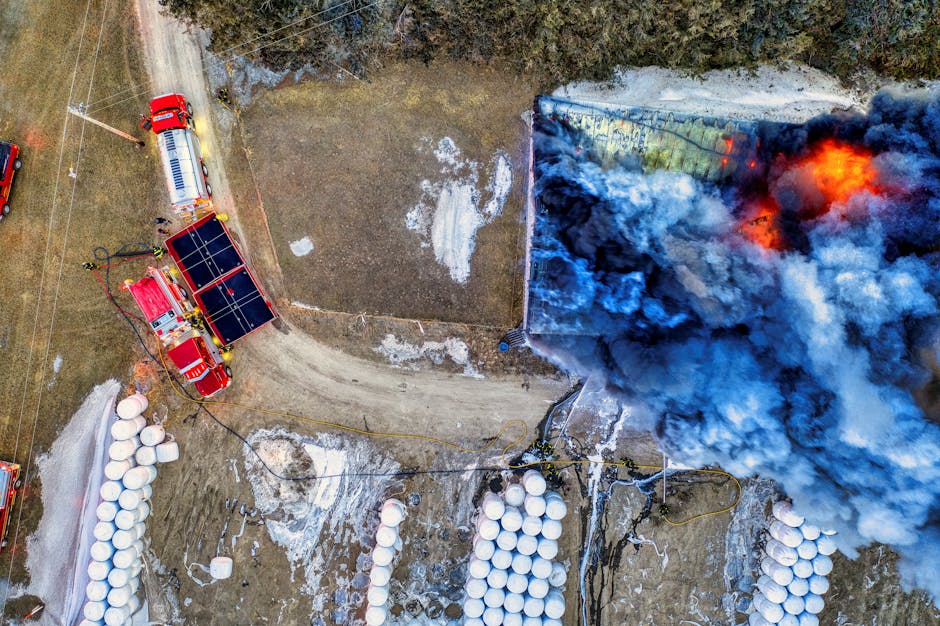
What is meant by “critical infrastructure”?
The term “critical infrastructure” refers to the assets, systems, and networks that are essential to the functioning of a society. These include, but are not limited to, electricity generation and distribution, water treatment and delivery, transportation hubs, telecommunications, financial services, health‑care facilities, and emergency‑response systems. When any of these components fail, the impact ripples outward, affecting everyday life, public safety, and the economy.
Governments worldwide categorize these assets under national security or resilience frameworks. In the United States, for example, the Department of Homeland Security’s Critical Infrastructure Sectors list 16 sectors, each with its own set of interdependencies. Recognising what belongs to critical infrastructure is the first step toward protecting it.
Why hazardous incidents pose a unique risk
Hazardous incidents encompass a broad range of events that can damage or disable infrastructure. They fall into three main categories:
- Natural hazards – earthquakes, hurricanes, floods, wildfires, and severe storms.
- Technological accidents – chemical spills, industrial explosions, nuclear releases, and large‑scale power outages.
- Human‑caused threats – terrorism, sabotage, and cyber‑physical attacks that result in physical damage.
Each category brings distinct challenges:
- Natural hazards are often unpredictable in timing and intensity, but their geographic footprints can be modeled.
- Technological accidents may arise from aging equipment, inadequate maintenance, or human error.
- Human‑caused threats can be targeted, exploiting known vulnerabilities to achieve maximum disruption.
The common thread is that any of these incidents can interrupt the flow of essential services, creating cascading failures that amplify the original impact. Because critical infrastructure is tightly interlinked, a disturbance in one sector quickly spreads to others.
How past incidents illustrate the need for preparation
Historical examples make the risk concrete:
Hurricane Katrina (2005)
The storm devastated New Orleans’ levee system, flooded hospitals, and crippled the regional power grid. The interruption of electricity and clean water forced many health‑care facilities to evacuate patients, while emergency‑services struggled to coordinate a response across collapsed communication networks.
Norfolk Chemical Plant Explosion (2012)
An explosion at a chlorine‑based plant released toxic gases, forcing the shutdown of nearby water‑treatment plants and a major highway. The incident demonstrated how a single industrial accident can jeopardize both public health and transportation routes.
Blackout in Ukraine (2022)
Coordinated cyber‑physical attacks on the national power grid left millions without electricity for weeks. The outage disrupted heating, water supply, and medical services, underscoring the overlap between cyber threats and physical hazards.
These cases share a pattern: insufficient pre‑incident planning led to prolonged service outages, higher casualty numbers, and inflated recovery costs. The lessons are clear—pre‑emptive preparation saves lives and reduces economic loss.
Key components of an effective preparedness program
A robust preparedness strategy integrates several disciplines. The following components form a practical baseline for any organization that owns or operates critical assets.
- Risk identification and assessment – Map hazards, evaluate likelihood, and estimate potential impact on each asset.
- Vulnerability analysis – Examine design, age, maintenance history, and location to locate weak points.
- Business‑continuity planning (BCP) – Define essential functions, establish recovery time objectives (RTOs), and outline alternate operating procedures.
- Incident‑response planning – Create clear, actionable steps for detection, containment, mitigation, and communication.
- Training and exercises – Conduct regular tabletop drills, functional simulations, and full‑scale exercises with all stakeholders.
- Redundancy and hardening – Build backup systems, diversify supply chains, and reinforce physical structures.
- Monitoring and early‑warning systems – Deploy sensors, weather‑alert services, and real‑time data platforms to catch threats early.
- Collaboration with external partners – Align with local emergency management agencies, utilities, and private‑sector partners.
Risk identification and assessment: a step‑by‑step guide
Risk assessment is the foundation on which every other preparedness activity rests. A practical approach follows these steps:
- Inventory assets – List every facility, piece of equipment, and supporting system that delivers the core service.
- Identify hazard scenarios – Use historical data, climate models, and threat intelligence to compile a catalog of possible incidents.
- Estimate likelihood – Assign probability ranges (e.g., rare, occasional, probable) based on frequency data and expert judgment.
- Determine consequences – Quantify potential loss of life, economic cost, regulatory penalties, and reputational damage for each scenario.
- Prioritise risks – Combine likelihood and consequence to rank risks, focusing resources on the highest‑rated threats.
Tools such as Failure Modes and Effects Analysis (FMEA) or the Hazard and Operability Study (HAZOP) can help structure this work. The output should be a living risk register, updated whenever new data emerges or assets change.
Understanding interdependencies and cascading effects
Critical infrastructure does not operate in isolation. Power outages can disable water‑pumping stations; a compromised telecommunications network can hinder emergency‑response coordination. Mapping these interconnections is essential for realistic scenario planning.
Two techniques are commonly used:
- Dependency matrices – Table rows and columns represent assets; cells indicate the direction and strength of dependence.
- System dynamics models – Simulate how a shock to one node propagates through the network over time.
When an interdependency map reveals a single point of failure, organisations can target that node for redundancy or reinforcement, dramatically reducing the chance of a cascade.
Business‑continuity planning for essential services
Business‑continuity planning (BCP) translates risk assessment into operational safeguards. A concise BCP includes:
- Critical function list – Identify the services that must remain operational (e.g., power generation, water purification).
- Recovery objectives – Define how quickly each function must be restored (RTO) and the maximum tolerable downtime.
- Alternate work sites – Secure backup locations, mobile generators, or cloud‑based platforms.
- Resource inventory – Catalog spare parts, fuel reserves, and personnel qualifications.
- Communication protocol – Outline who notifies whom, through which channels, and what information is shared.
BCP documents must be concise enough for quick reference during an emergency yet detailed enough to guide decision‑making under stress.
Incident‑response planning: From detection to recovery
Effective response hinges on clear roles, rapid information flow, and predefined actions. A typical response cycle comprises:
- Detection – Sensors, alarms, or staff reports signal an abnormal condition.
- Assessment – A qualified officer evaluates severity, scope, and potential impact.
- Containment – Immediate measures are taken to prevent escalation (e.g., shutting down a valve, isolating a network segment).
- Mitigation – Actions that reduce damage, such as deploying fire‑suppression systems or activating emergency generators.
- Recovery – Restoration of normal operations according to the BCP.
- After‑action review – Document lessons learned and update plans.
Each phase should have a designated “incident commander” and a supporting “operations team” that knows their check‑lists.
Training, exercises, and the value of realism
Plans that are never tested become paper exercises. Regular training builds muscle memory and reveals hidden gaps. Consider three tiers of practice:
- Tabletop drills – Narrative‑based discussions that walk participants through a scenario without physical actions.
- Functional exercises – Activate specific components such as emergency‑power systems or communication protocols.
- Full‑scale simulations – Realistic, multi‑agency events that mimic the chaos of an actual incident.
After each exercise, conduct a structured debrief. Capture what worked, what failed, and what requires revision. Over time, the organisation’s “response culture” becomes more resilient.
Physical hardening and redundancy: Investing where it matters
Not all assets can be made immune to hazards, but many vulnerabilities can be reduced through engineering controls:
- Seismic retrofitting – Strengthen foundations, add damping systems, and secure equipment to resist earthquakes.
- Flood barriers – Install levees, floodwalls, or watertight doors around low‑lying facilities.
- Fire‑suppression upgrades – Replace standard sprinkler systems with foam‑based or inert‑gas solutions for high‑risk zones.
- Backup power – Deploy on‑site generators, battery storage, or micro‑grids to maintain critical loads.
- Redundant communications – Use satellite phones, mesh networks, and hardened radio systems alongside conventional lines.
Redundancy should be balanced against cost. A risk‑based approach ensures that investments target the most consequential failure points.
Early‑warning systems and real‑time monitoring
Timely information is the cornerstone of any mitigation effort. Modern monitoring combines traditional sensors with digital analytics:
- Environmental sensors – Measure temperature, humidity, vibration, radiation, and chemical concentrations.
- SCADA (Supervisory Control and Data Acquisition) – Provides real‑time data on flow rates, pressures, and equipment status.
- Weather‑alert services – Subscribe to NOAA, Met Office, or regional agencies for storm and flood warnings.
- Cyber‑physical intrusion detection – Monitors network traffic for anomalous commands that could indicate sabotage.
Data from these sources feed into a central Operations Center where threshold‑based alarms trigger predefined response actions.
Collaboration with external partners
No single organisation can safeguard an entire infrastructure ecosystem alone. Effective collaboration involves:
- Local emergency management agencies – Align incident‑command structures and share resource inventories.
- Utility providers – Coordinate backup power, fuel deliveries, and grid restoration priorities.
- Regulatory bodies – Ensure compliance with safety standards such as NFPA 70E, ISO 22301, or the EU NIS Directive.
- Industry peers – Participate in information‑sharing platforms like the Critical Infrastructure Protection (CIP) community.
Formal memoranda of understanding (MOUs) codify these relationships, clarifying who does what during an emergency.
Regulatory expectations and standards
Many jurisdictions impose minimum preparedness requirements. While specifics vary, common references include:
- ISO 22301 – Business Continuity Management Systems: Provides a framework for planning, implementing, and improving continuity.
- NFPA 1600 – Standard on Continuity, Emergency, and Crisis Management: Guides the development of comprehensive emergency programs.
- IEC 62443 – Industrial Automation and Control Systems Security: Addresses cybersecurity aspects that can lead to physical hazards.
- National Institute of Standards and Technology (NIST) SP 800‑53: Offers a catalog of security and privacy controls relevant to critical infrastructure.
Compliance audits often examine documentation, training records, and test results. Demonstrating adherence not only satisfies regulators but also builds stakeholder confidence.
Measuring preparedness: Metrics that matter
To track progress, organisations use performance indicators that reflect real capability:
- Mean Time to Detect (MTTD) – Average time from incident onset to awareness.
- Mean Time to Respond (MTTR) – Time from detection to the initiation of containment measures.
- Recovery Point Objective (RPO) – The maximum tolerable data loss measured in time.
- Recovery Time Objective (RTO) – The target time to restore a specific function.
- Exercise success rate – Percentage of drill objectives achieved without major deviations.
Regularly reviewing these metrics highlights improvement areas and justifies further investment.
Common misconceptions that hinder preparation
Several myths persist in the industry:
- “We’re too small to be a target.” Even modest facilities can become collateral damage in a larger event or be deliberately targeted for strategic impact.
- “If we build a strong fence, we’re safe.” Physical barriers address only a subset of hazards; they do not mitigate floods, cyber‑physical attacks, or internal failures.
- “Our insurance will cover any loss.” Insurance can reimburse financial losses but does not replace lost lives, reputation, or the societal cost of service interruption.
- “We’ve complied once, so we’re done.” Regulations evolve, and risk environments shift. Continuous review is mandatory.
Dispelling these myths encourages a proactive, rather than reactive, posture.
Future‑proofing: Adapting to evolving threats
While the article avoids speculative predictions, it is prudent to recognise two enduring trends:
- Climate change – Increases frequency and severity of extreme weather, expanding the footprint of natural hazards.
- Convergence of cyber and physical domains – As control systems become more connected, a cyber intrusion can trigger a physical incident.
Embedding flexibility into designs—such as modular backup systems and software‑defined networking—helps organisations adjust without costly overhauls.
